
Surviving In The Death Trade
The death trade is not easy to be in. It takes a certain kind of character to be in it, much less stay in it.
I had a rude cultural shock when I first entered this trade but I have since come to embrace the culture that is very unique to the death trade. Most of the longer standing establishments are family owned and needless to say, are less structured. In this trade, academic achievements have close to zero use, especially if you’re venturing into the operations side of things. In fact, one can go far only with the network of connections he/she builds in this trade. The people in this trade are almost always interconnected (e.g. company A’s child owns company B, etc.) and hence at times, it can very much feel like a small “kampung” where what happens today is known to the entire village the very next day. The good thing about this is that unlike in the corporate world where gatherings are very formal and sometimes a tad superficial (at least to me), the meet-ups between people in this trade can exude a more laid back and authentic vibe.
Do not expect to be handheld in this trade. Unlike big corporations where there are formal trainings and employee handbooks to guide a newcomer, such terms are unheard of for most companies especially when I first entered 5.5 years ago (we have since came up with an employee handbook and a schedule of trainings for new employees). How fast one progresses in this trade depends very largely on how hungry he or she wants to succeed in life. Since education does not play a huge role in determining the career trajectory of one in this trade, it is a fair playing field for all who enter to excel in this trade. This also means that as long as you are willing to work your ass off and be smart about it, it is tough not to do sufficiently well in the death trade. I was working almost daily, 24/7 when I first entered the funeral industry as I believed in giving my best in whatever I am tasked to do.
I was an irritating inquisitive apprentice, always hounding the older folks in this trade for answers to my questions. The learning curve was steep as there was no instructional manual on how things should be done. Learning was made even tougher by the fact that each and every religious leader had slightly different ways of conducting the rituals even if it was within the same religion and dialect. Being the kinesthetic learner I am, I took down copious amounts of notes with my amateur drawings so as to make sure I learn what I needed to in the funeral trade.
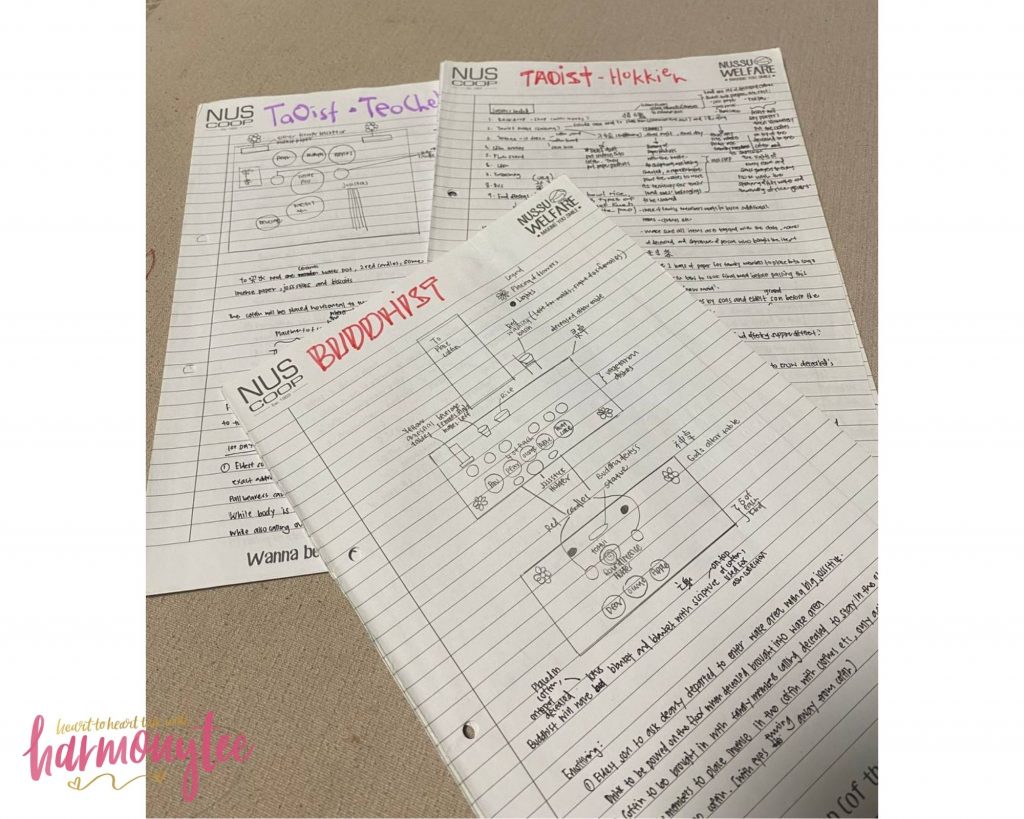
If you are unwilling to sacrifice your social life, this trade isn’t going to be for you. Death is unpredictable and hence expect your meals to be disrupted by work calls that require your immediate attention. Get ready to bid goodbye to friends who might not be as understanding of your erratic working hours (I personally lost quite a number of friends including a boyfriend because of that and this is actually the toughest sacrifice for me).
Being a female in a male-dominated industry is a double-edged sword. The fact remains that physically, I might not be as adept as the males in the trade. To counter this, I work doubly hard to ensure I am familiar with the ins and outs of every funeral and made sure to improvise on anything I manage to have my hands laid on. From changing clothes for the decedent upon collection of the body all the way to collection of the ashes at the crematorium, I got my hands dipped into each and every processes. Outside of formal working hours, I would take time to understand and befriend others in the same trade to build the rapport needed to work together.

All in all, working in the funeral trade might seem like a very noble and glamourous job but I guarantee you it is not as easy as it seems and most people actually leave within 3 months. Ultimately, you need to be able to see and believe in the over-arching purpose of what you’re doing. For me, I strongly believe it to be a calling to serve and walk alongside people in their grieving journey for this season. It is paramount to always have this purpose emblazoned in your mind.
In everything that you do, it will not always be smooth sailing but remembering why you started doing what you do in the first place will help get you through tough times.
Till then,
Harmony Tee